What Is a Unity Ceremony?
Real talk family. How are you enjoying our traditional wedding series? Let’s dive right into the unity ceremony. The unity ceremony is an optional part of a wedding when couples perform a symbolic act representing their union. Unlike the exchange of vows, a unity ceremony isn't required for a valid marriage. It is a meaningful tradition couples can personalize to reflect their relationship, culture, faith, family, or values. It is important for the symbol to have meaning before couples give it a place in their ceremony.
Some unity ceremonies are centuries old. Because there are so many options for couples to personalize, this article will only highlight a common few, including the Unity Candle: Two Flames, One Light, which is possibly the most recognizable unity ceremony often practiced even today because the symbolism is so easy to understand. For Christian couples, the candle can also become a beautiful reminder of Christ's presence in their marriage. Jesus said: "I am the light of the world." John 8:12 (NIV)
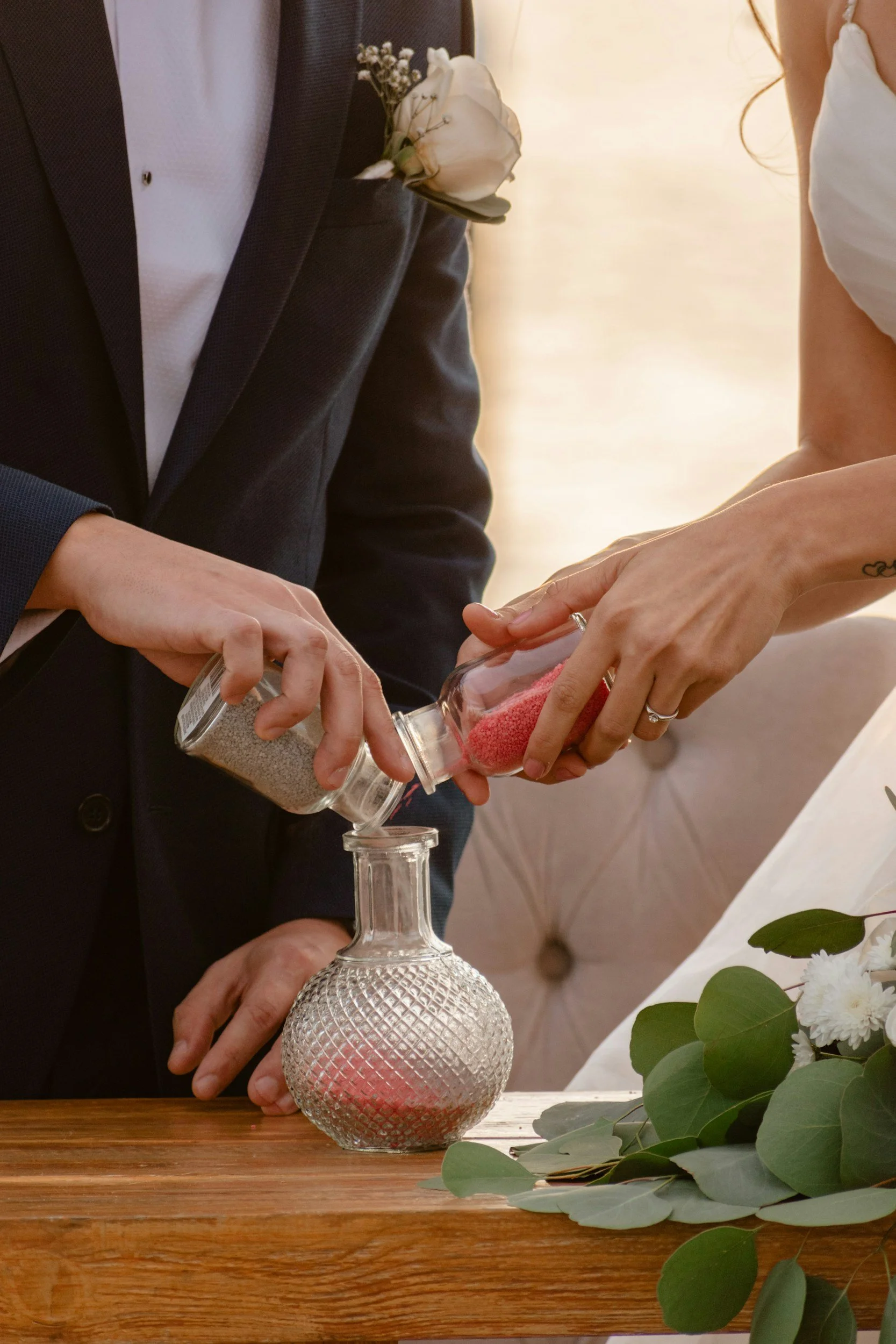
The Unity Sand ceremony, housed in separate containers, often with different colors to symbolize each life, involves the bride and groom pouring their sand into a shared vessel, creating a new pattern that represents their marriage. The beauty is in the permanence. Once the grains are combined, separating every grain back into its original container becomes nearly impossible. However, it also demonstrates the important fact that combining two lives does not mean you lose your identity. You're still yourself.
Another popular ceremony is Handfasting which represents choosing to be bound together. Handfasting is a historic wedding custom in which a couple's hands are joined or bound with cords, ribbons, or fabric. The practice has been associated particularly with Celtic and European traditions, although historical interpretations and modern practices vary. Today, couples may incorporate handfasting as a symbolic representation of commitment, unity, and joining their lives together. Their hands will eventually hold a baby, wipe tears, sign mortgage documents, celebrate victories, and grow older together. That's covenant made visible.
Our last ceremony is the Unity Wine: Sharing One Cup. A unity wine ceremony involves the couple pouring wine into a shared glass or drinking from the same cup. For some couples, the symbolism represents shared life, celebration, hospitality, and the willingness to receive life's experiences together. For Christian couples, the imagery of a shared cup can also invite reflection on biblical themes of covenant and sacrifice.
Unity is built through knowing. Being married doesn't automatically mean being connected. Proximity isn't intimacy. So don’t just plan the symbol, commit to unity in your marriage. I'm so grateful that unity continues to grow in my marriage. I pray the same for your union as well. Small acts of unity, repeated consistently, can change the atmosphere of a marriage.
Wedding Tradition Fact
Unity ceremonies have become increasingly popular in modern weddings. There is no single Christian unity ritual prescribed by Scripture. Couples should enjoy these traditions without confusing symbolism with covenant. Your ceremony simply gives you a beautiful picture of what you've promised.
Reflection Tip
Find a quiet moment with your spouse and complete the following sentences separately then share your answers.
One way I see us becoming more united is...
One area where I would love for us to become more connected is...
What is one thing we can do together this week to strengthen our unity?"
Prayer for Couples
Thank you Father God, in the name of Jesus, for the gift of covenant and for the beautiful opportunity to build a life with someone we love. Help us understand that becoming one is more than a moment in a wedding ceremony. Teach us to practice unity in our everyday lives, decisions, communication, finances, families, dreams, and our faith. Help us protect our connection when life becomes busy. Help us choose partnership when we disagree. Help us serve one another with humility and love.
Where we have become disconnected, bring us back together. Where we have allowed pride to create distance, give us humility. Where we have experienced hurt, bring healing. Above all, help us to keep You at the center of our covenant so that our marriages become a living testimony of Your love, grace, faithfulness, and redemption. In Jesus' name, Amen.
Promise To Love
Real talk family. Traditional wedding vows are beautiful but most of the familiar wedding vow language ("for better, for worse," "for richer, for poorer," etc.) is not quoted directly from Scripture. Traditional vows were developed over centuries by the Church to summarize biblical principles of covenant marriage. In fact, before wedding ceremonies, wedding bands, and traditional vows, Scripture gave couples a blueprint for what covenant love should look like.
A good example of a marital Foundational Biblical Principle (FBP) is Genesis 2:24 (NIV) "That is why a man leaves his father and mother and is united to his wife, and they become one flesh." This is a promise to leave and cleave. It places the marital relationship as of greater priority than the relationship between parent in child(ren). Don’t misunderstand. There is great responsibility in becoming a parent. But as an adult, when you marry, you build a new family identity with your spouse. This vow is about prioritizing one another above all else, second to God alone. Because we’ve worked with many couples, we can attest that unhealthy boundaries or out-of-order relationships leads to great dysfunction and unnecessary marital strain.
Other biblical guidance for couples include Ephesians 5:25 (NIV) "Husbands, love your wives, just as Christ loved the church and gave himself up for her." This is one of my favorites and is relevant to both spouses. This guidance ensures that personal selfishness does not lead to any marital mistreatment but totally opposite of that. This promise is sacrificial love. This guidance also includes acts of service, generous giving, and unconditional love. In my opinion, all the other vows can hang on this one scripture along - or better, for worse," "for richer, for poorer,” “in sickness, in health”, everything you say from traditional vows or vows you write for yourself.
And let’s not forget Romans 12:10 (NIV) "Be devoted to one another in love. Honor one another above yourselves." Honor influences so many aspects of our marriages including communication, conflict resolution, affection, and relationship behaviors. Many marriages didn’t end because love faded away but more because honor disappeared. Remember, love cannot be a fleeting emotion. You must choose to love, remain committed, and honor your vows (did you see my wordplay there?).
God’s Word is true, pure, and complete. Scripture even gave a roadmap for intimacy when we consider Hebrews 13:4 (NIV) "Marriage should be honored by all, and the marriage bed kept pure..." I personally feel this is a promise to protect our covenant emotionally, spiritually, physically, and sexually. It includes protecting ourselves and guarding our marriages. Faithfulness is more than just avoiding physical infidelity. It also represents emotional loyalty and connection.
And while there are many others to explore on your own, I’ll close with Colossians 3:13 (NIV) "Bear with each other and forgive one another..." Forgiveness protects the covenant from bitterness. Remember that there is only one who is perfect. His name is Jesus (not whatever your spouse is named!). We must practice grace, and forgiveness, first with our spouses, then everyone else. God’s Word teaches us that we all will experience trouble. Life is full of trouble. Marriages will experience trouble. But be encouraged. Christ overcame the world. We are overcomers too. Consider for a moment what God’s forgiveness has done for you. It redeemed you. Put you back in covenant with God. It released you from living in condemnation. It met you in your dirt and made you white as snow. No record or scorekeeping, just love. Do you see where I’m going with this. Think how much true forgiveness could change your marriage.
There is so much more. Search the scriptures. Don’t settle for just traditional vows. Again, there is so much more. I’ll leave you with this - Ecclesiastes 4:12 (NIV) "A cord of three strands is not quickly broken." Keep God in your marriage and take each day as a new opportunity to glorify HIM with your covenant. Love and blessings, j&c